TANUH-CBR IndiNeuroFM
TANUH-CBR IndiNeuroFM
TANUH-CBR IndiNeuroFM
A Multimodal AI Platform for India-Specific Neurological Intelligence
A Multimodal AI Platform for India-Specific Neurological Intelligence
A Multimodal AI Platform for India-Specific Neurological Intelligence


Overview
Overview
Overview
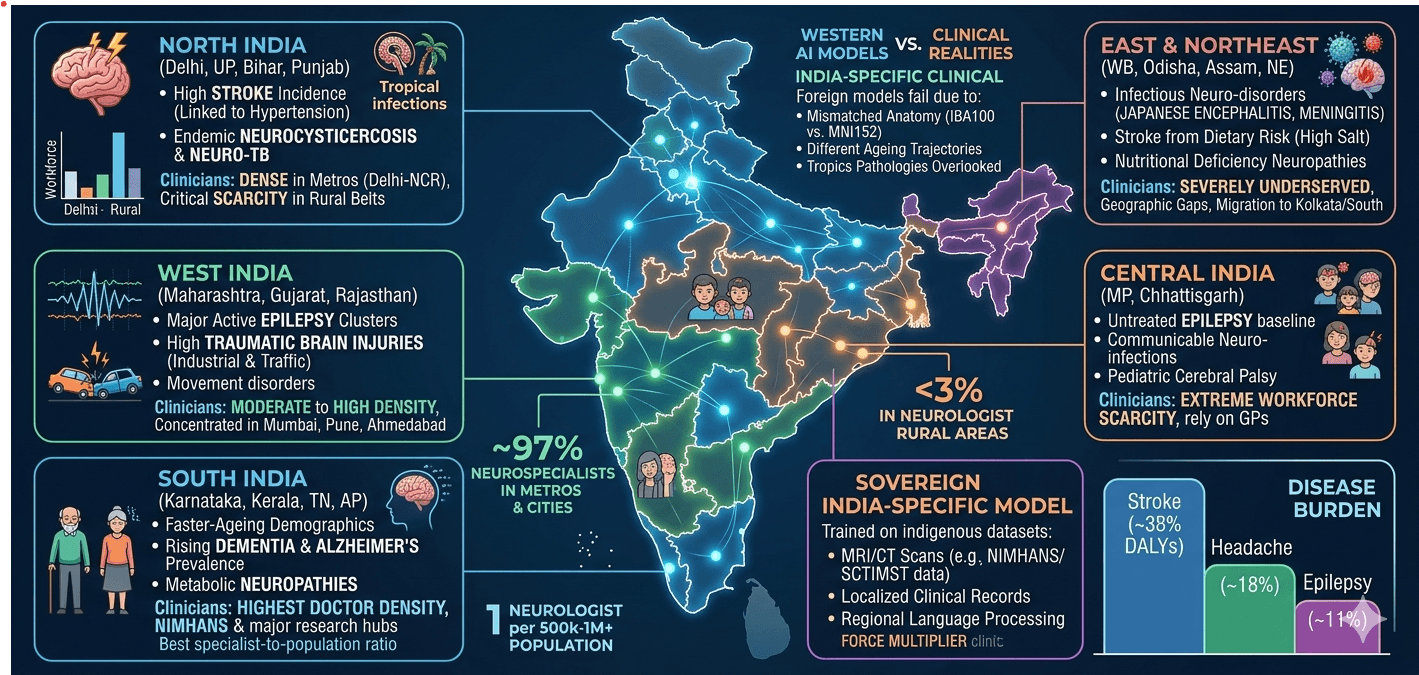
Neurological disorders are complex, data-intensive, and deeply influenced by population-specific factors such as anatomy, ageing patterns, and disease prevalence. However, most existing medical AI models are trained on Western datasets, making them poorly suited for Indian populations.
India presents unique neurological characteristics—from differences in brain structure and ageing trajectories to higher prevalence of conditions like neuro-tuberculosis and nutritional deficiencies. These gaps result in reduced accuracy in diagnosis, limited clinical relevance, and inequitable healthcare outcomes.
This creates a critical need for a sovereign, India-specific medical foundation model that can understand and operate within the country’s clinical and demographic realities.
Neurological disorders are complex, data-intensive, and deeply influenced by population-specific factors such as anatomy, ageing patterns, and disease prevalence. However, most existing medical AI models are trained on Western datasets, making them poorly suited for Indian populations.
India presents unique neurological characteristics—from differences in brain structure and ageing trajectories to higher prevalence of conditions like neuro-tuberculosis and nutritional deficiencies. These gaps result in reduced accuracy in diagnosis, limited clinical relevance, and inequitable healthcare outcomes.
This creates a critical need for a sovereign, India-specific medical foundation model that can understand and operate within the country’s clinical and demographic realities.
Neurological disorders are complex, data-intensive, and deeply influenced by population-specific factors such as anatomy, ageing patterns, and disease prevalence. However, most existing medical AI models are trained on Western datasets, making them poorly suited for Indian populations.
India presents unique neurological characteristics—from differences in brain structure and ageing trajectories to higher prevalence of conditions like neuro-tuberculosis and nutritional deficiencies. These gaps result in reduced accuracy in diagnosis, limited clinical relevance, and inequitable healthcare outcomes.
This creates a critical need for a sovereign, India-specific medical foundation model that can understand and operate within the country’s clinical and demographic realities.
Our Solution
Our Solution
Our Solution
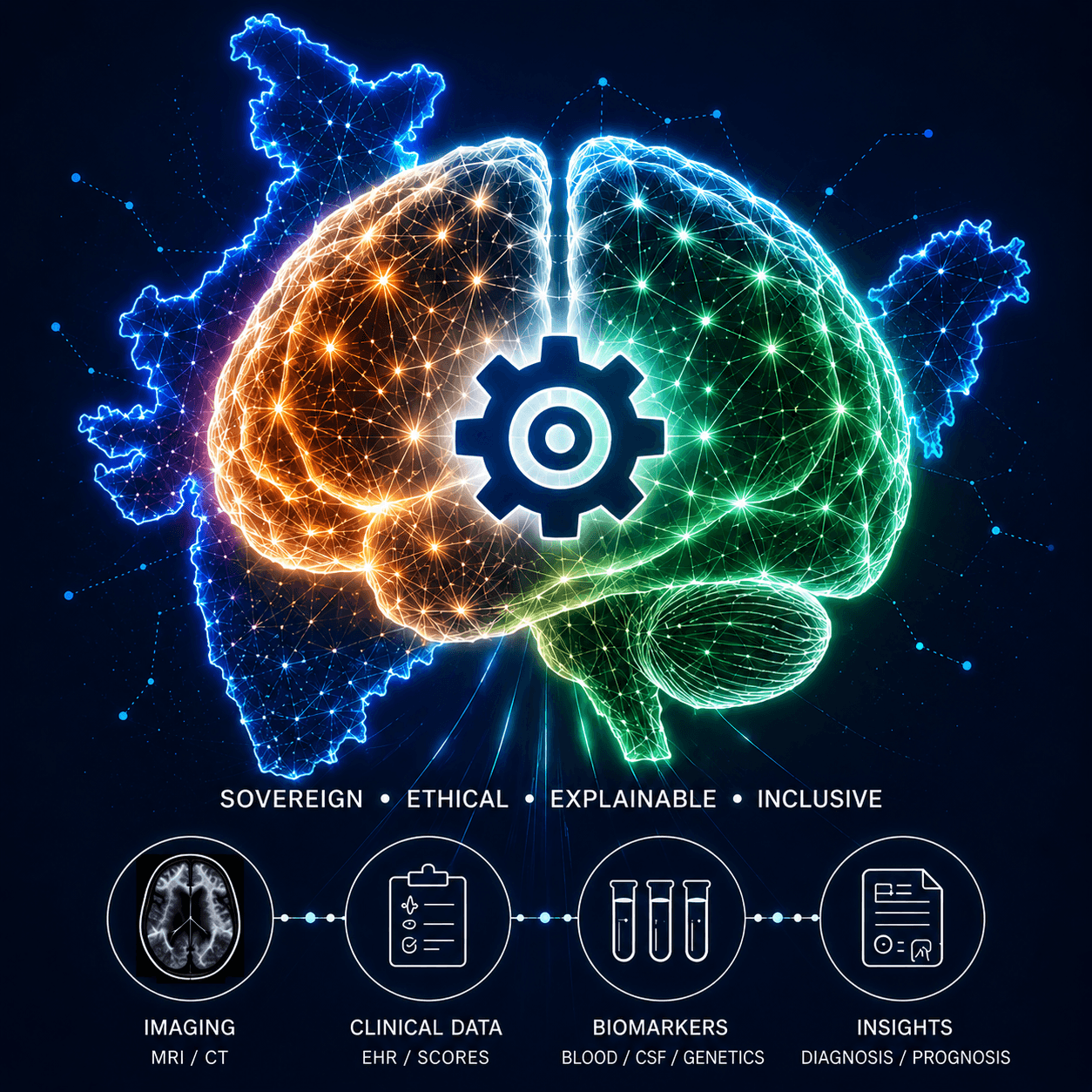
IndiNeuroFM is a Unified Multimodal Medical Foundation Model (UMMFM) designed specifically for the Indian brain.
It integrates imaging, clinical data, and biomarkers to enable accurate diagnosis, prognosis, and research across neurological conditions.
The platform acts as a multimodal bridge, connecting different forms of medical data to generate clinically meaningful insights at scale.
IndiNeuroFM is a Unified Multimodal Medical Foundation Model (UMMFM) designed specifically for the Indian brain.
It integrates imaging, clinical data, and biomarkers to enable accurate diagnosis, prognosis, and research across neurological conditions.
The platform acts as a multimodal bridge, connecting different forms of medical data to generate clinically meaningful insights at scale.
IndiNeuroFM is a Unified Multimodal Medical Foundation Model (UMMFM) designed specifically for the Indian brain.
It integrates imaging, clinical data, and biomarkers to enable accurate diagnosis, prognosis, and research across neurological conditions.
The platform acts as a multimodal bridge, connecting different forms of medical data to generate clinically meaningful insights at scale.
Solution 1: Multimodal Brain Intelligence Engine
Solution 1: Multimodal Brain Intelligence Engine
Solution 1: Multimodal Brain Intelligence Engine
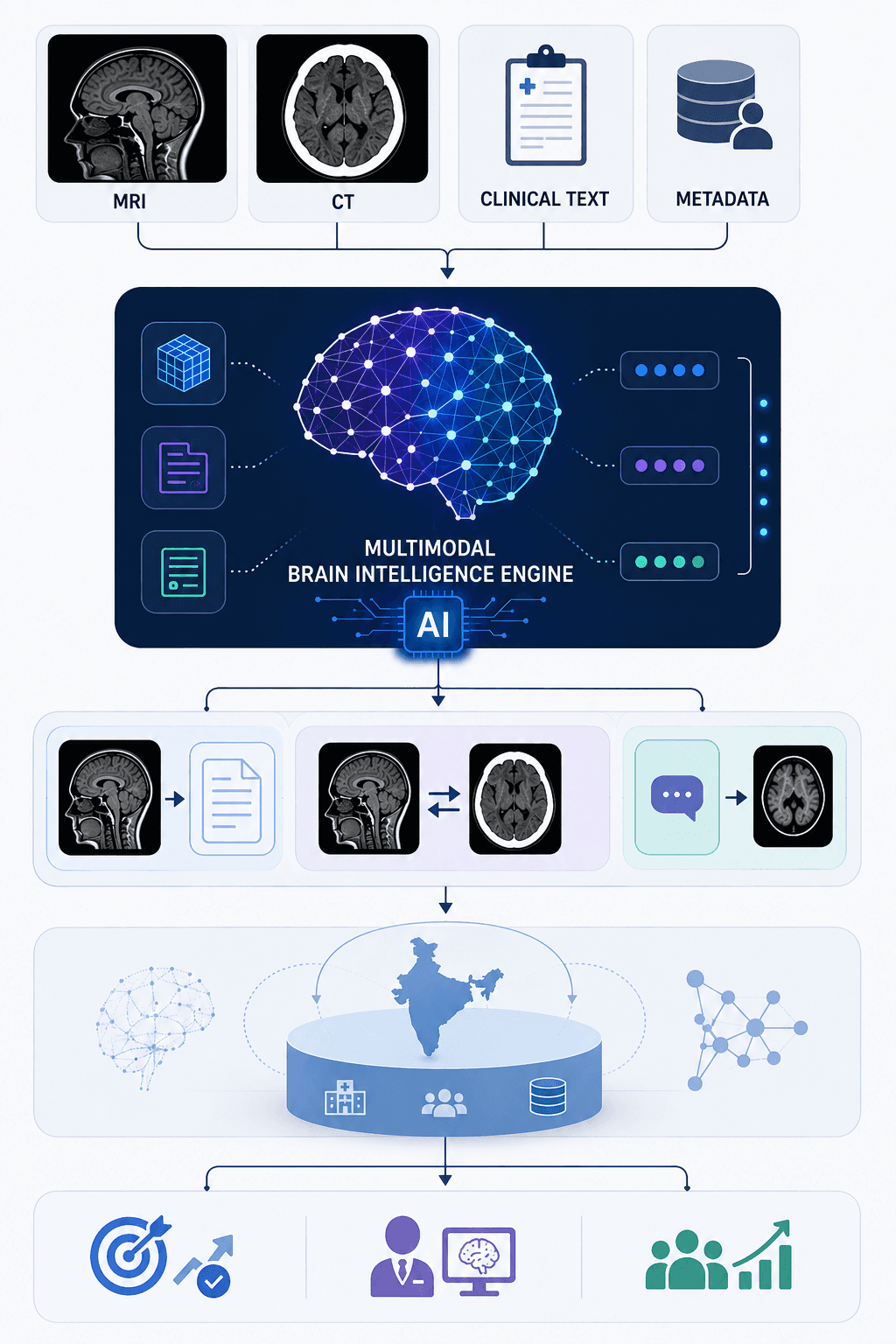
A foundation model that enables cross-modal understanding and generation across medical data types.
Capabilities:
Convert brain scans (MRI/CT) into structured clinical reports
Generate cross-modality imaging (MRI ↔ CT)
Create synthetic brain imaging from clinical prompts
Learn unified representations across imaging, text, and metadata
A foundation model that enables cross-modal understanding and generation across medical data types.
Capabilities:
Convert brain scans (MRI/CT) into structured clinical reports
Generate cross-modality imaging (MRI ↔ CT)
Create synthetic brain imaging from clinical prompts
Learn unified representations across imaging, text, and metadata
A foundation model that enables cross-modal understanding and generation across medical data types.
Capabilities:
Convert brain scans (MRI/CT) into structured clinical reports
Generate cross-modality imaging (MRI ↔ CT)
Create synthetic brain imaging from clinical prompts
Learn unified representations across imaging, text, and metadata
Goals
Goals
Goals
Improve diagnostic accuracy in neurological imaging
Improve diagnostic accuracy in neurological imaging
Improve diagnostic accuracy in neurological imaging
Reduce dependency on manual interpretation
Reduce dependency on manual interpretation
Reduce dependency on manual interpretation
Enable scalable clinical decision support
Enable scalable clinical decision support
Enable scalable clinical decision support
Key Features of the Solution:
Key Features of the Solution:
Key Features of the Solution:
Multimodal AI combining imaging, text, and metadata
Multimodal AI combining imaging, text, and metadata
Multimodal AI combining imaging, text, and metadata
3D volumetric understanding of brain scans
3D volumetric understanding of brain scans
3D volumetric understanding of brain scans
Structured “Neuro-Tuple” data architecture
Structured “Neuro-Tuple” data architecture
Structured “Neuro-Tuple” data architecture
Foundation model trained on India-specific datasets
Foundation model trained on India-specific datasets
Foundation model trained on India-specific datasets
Solution 2: Cognitive Impairment Staging & Prognostics
Solution 2: Cognitive Impairment Staging & Prognostics
Solution 2: Cognitive Impairment Staging & Prognostics
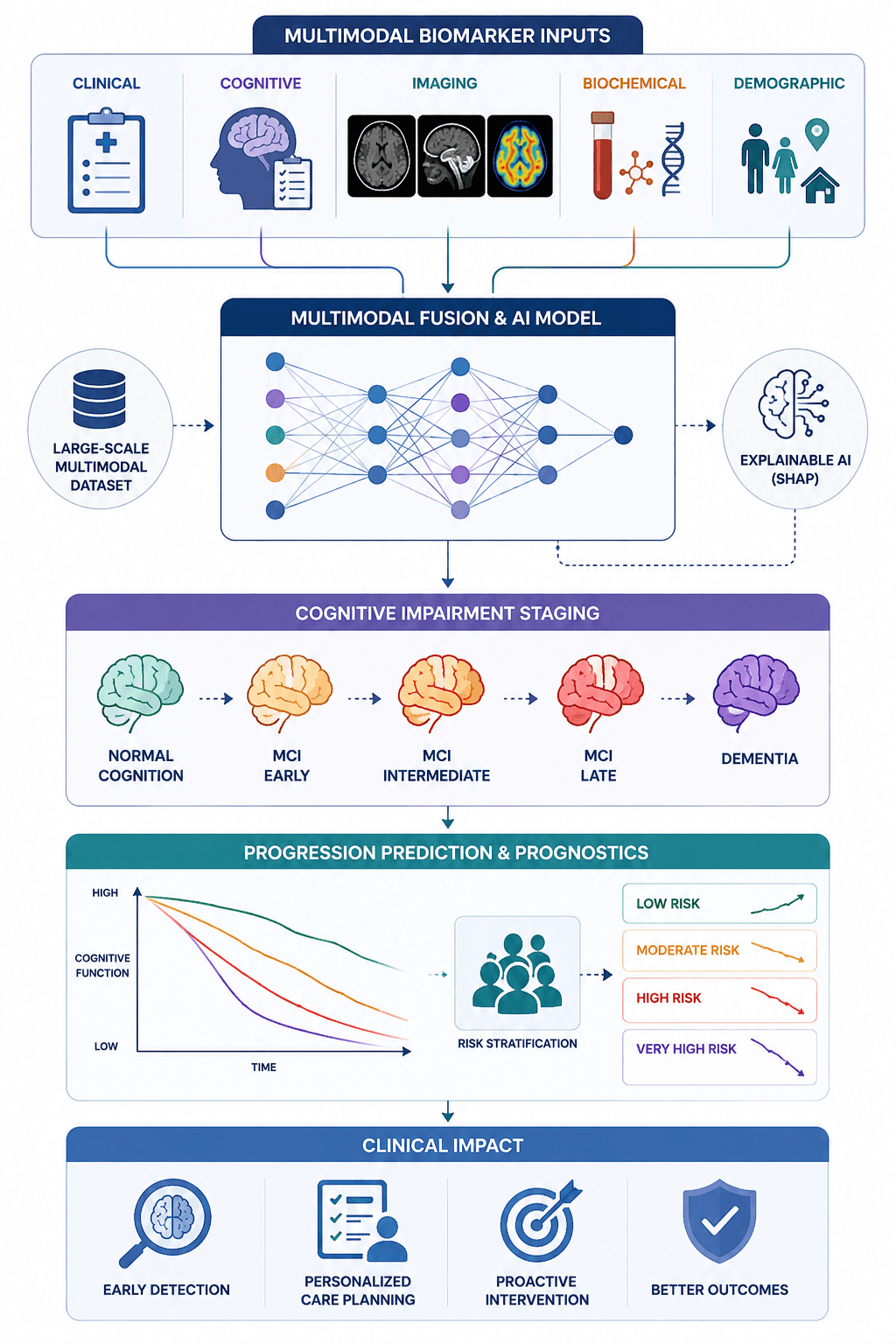
Uses multimodal biomarkers to classify and predict stages of cognitive impairment.
Capabilities:
Classify Mild Cognitive Impairment (MCI) stages
Predict progression trajectories of cognitive decline
Integrate clinical, cognitive, imaging, and biochemical data
Uses multimodal biomarkers to classify and predict stages of cognitive impairment.
Capabilities:
Classify Mild Cognitive Impairment (MCI) stages
Predict progression trajectories of cognitive decline
Integrate clinical, cognitive, imaging, and biochemical data
Uses multimodal biomarkers to classify and predict stages of cognitive impairment.
Capabilities:
Classify Mild Cognitive Impairment (MCI) stages
Predict progression trajectories of cognitive decline
Integrate clinical, cognitive, imaging, and biochemical data
Goals
Goals
Goals
Enable early detection of cognitive decline
Enable early detection of cognitive decline
Enable early detection of cognitive decline
Support proactive intervention and care planning
Support proactive intervention and care planning
Support proactive intervention and care planning
Differentiate normal ageing from pathological conditions
Differentiate normal ageing from pathological conditions
Differentiate normal ageing from pathological conditions
Key Features of the Solution:
Key Features of the Solution:
Key Features of the Solution:
Large-scale multimodal dataset (clinical + imaging + biomarkers)
Large-scale multimodal dataset (clinical + imaging + biomarkers)
Large-scale multimodal dataset (clinical + imaging + biomarkers)
Population-specific modelling across rural and urban cohorts
Population-specific modelling across rural and urban cohorts
Population-specific modelling across rural and urban cohorts
Explainable AI using SHAP for transparent decision-making
Explainable AI using SHAP for transparent decision-making
Explainable AI using SHAP for transparent decision-making
Clinically grounded biomarker prioritization
Clinically grounded biomarker prioritization
Clinically grounded biomarker prioritization
Impact & Vision
Impact & Vision
Impact & Vision
Current Impact:
Current Impact:
Current Impact:
Building India’s first sovereign neurological foundation model
Training on 70,000+ brain imaging volumes across MRI and CT modalities
Leveraging 20,000+ multimodal clinical, cognitive, and biomarker data points
Advancing state-of-the-art performance in:
Imaging segmentation and analysis
Clinical report generation
Cognitive impairment classification (>85% target accuracy)
Enabling explainable AI for transparent and clinically interpretable decisions
Powering multi-institutional collaboration across hospitals, diagnostics, and research centres in India
Addressing population-specific gaps in diagnosis for conditions like neuro-infections, nutritional deficiencies, and atypical ageing patterns
Building India’s first sovereign neurological foundation model
Training on 70,000+ brain imaging volumes across MRI and CT modalities
Leveraging 20,000+ multimodal clinical, cognitive, and biomarker data points
Advancing state-of-the-art performance in:
Imaging segmentation and analysis
Clinical report generation
Cognitive impairment classification (>85% target accuracy)
Enabling explainable AI for transparent and clinically interpretable decisions
Powering multi-institutional collaboration across hospitals, diagnostics, and research centres in India
Addressing population-specific gaps in diagnosis for conditions like neuro-infections, nutritional deficiencies, and atypical ageing patterns
Building India’s first sovereign neurological foundation model
Training on 70,000+ brain imaging volumes across MRI and CT modalities
Leveraging 20,000+ multimodal clinical, cognitive, and biomarker data points
Advancing state-of-the-art performance in:
Imaging segmentation and analysis
Clinical report generation
Cognitive impairment classification (>85% target accuracy)
Enabling explainable AI for transparent and clinically interpretable decisions
Powering multi-institutional collaboration across hospitals, diagnostics, and research centres in India
Addressing population-specific gaps in diagnosis for conditions like neuro-infections, nutritional deficiencies, and atypical ageing patterns
Future Vision:
Future Vision:
Future Vision:
To establish a sovereign, India-first AI infrastructure for neurological healthcare
To enable accurate, equitable, and population-specific diagnosis across diverse Indian contexts
To build a unified multimodal intelligence layer connecting imaging, clinical data, and biomarkers
To support early detection and proactive care for neurological and cognitive disorders
To create a scalable foundation for future medical AI innovation in India and the Global South
To drive clinically grounded, transparent, and ethical AI systems for real-world deployment
To establish a sovereign, India-first AI infrastructure for neurological healthcare
To enable accurate, equitable, and population-specific diagnosis across diverse Indian contexts
To build a unified multimodal intelligence layer connecting imaging, clinical data, and biomarkers
To support early detection and proactive care for neurological and cognitive disorders
To create a scalable foundation for future medical AI innovation in India and the Global South
To drive clinically grounded, transparent, and ethical AI systems for real-world deployment
To establish a sovereign, India-first AI infrastructure for neurological healthcare
To enable accurate, equitable, and population-specific diagnosis across diverse Indian contexts
To build a unified multimodal intelligence layer connecting imaging, clinical data, and biomarkers
To support early detection and proactive care for neurological and cognitive disorders
To create a scalable foundation for future medical AI innovation in India and the Global South
To drive clinically grounded, transparent, and ethical AI systems for real-world deployment
Team & Collaborators
Team & Collaborators
Team & Collaborators
Investigators
Investigators
Investigators
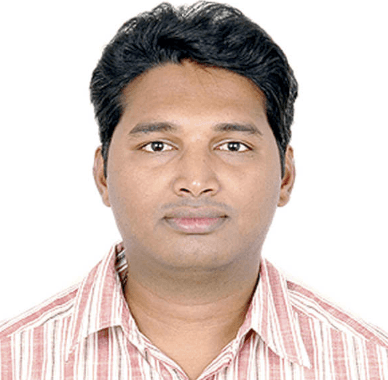
Phaneendra K. Yalavarthy
Phaneendra K. Yalavarthy
Phaneendra K. Yalavarthy
Professor
Department of Computational and Data Sciences, IISc
Personal website
Professor
Department of Computational and Data Sciences, IISc
Personal website
Professor
Department of Computational and Data Sciences, IISc
Personal website
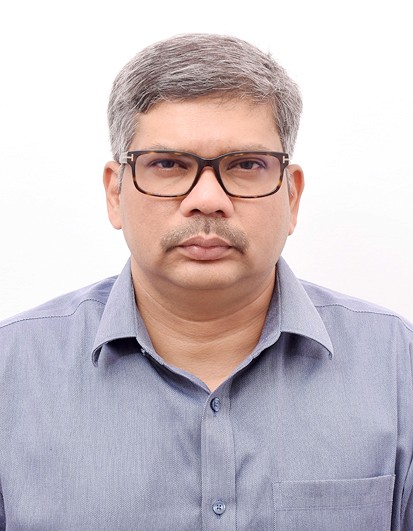
Ambedkar Dukkipati
Ambedkar Dukkipati
Ambedkar Dukkipati
Professor
Computer Science and Automation, IISc
Personal website
Professor
Computer Science and Automation, IISc
Personal website
Professor
Computer Science and Automation, IISc
Personal website
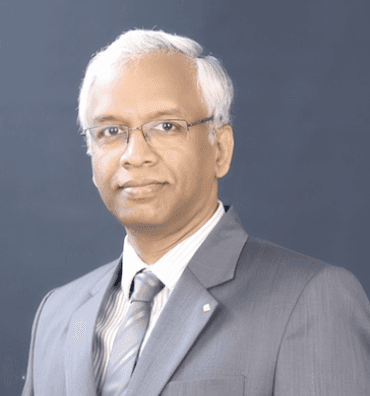
K. V. S. Hari
K. V. S. Hari
K. V. S. Hari
Director
Centre for Brain Research, IISc
Personal website
Director
Centre for Brain Research, IISc
Personal website
Director
Centre for Brain Research, IISc
Personal website
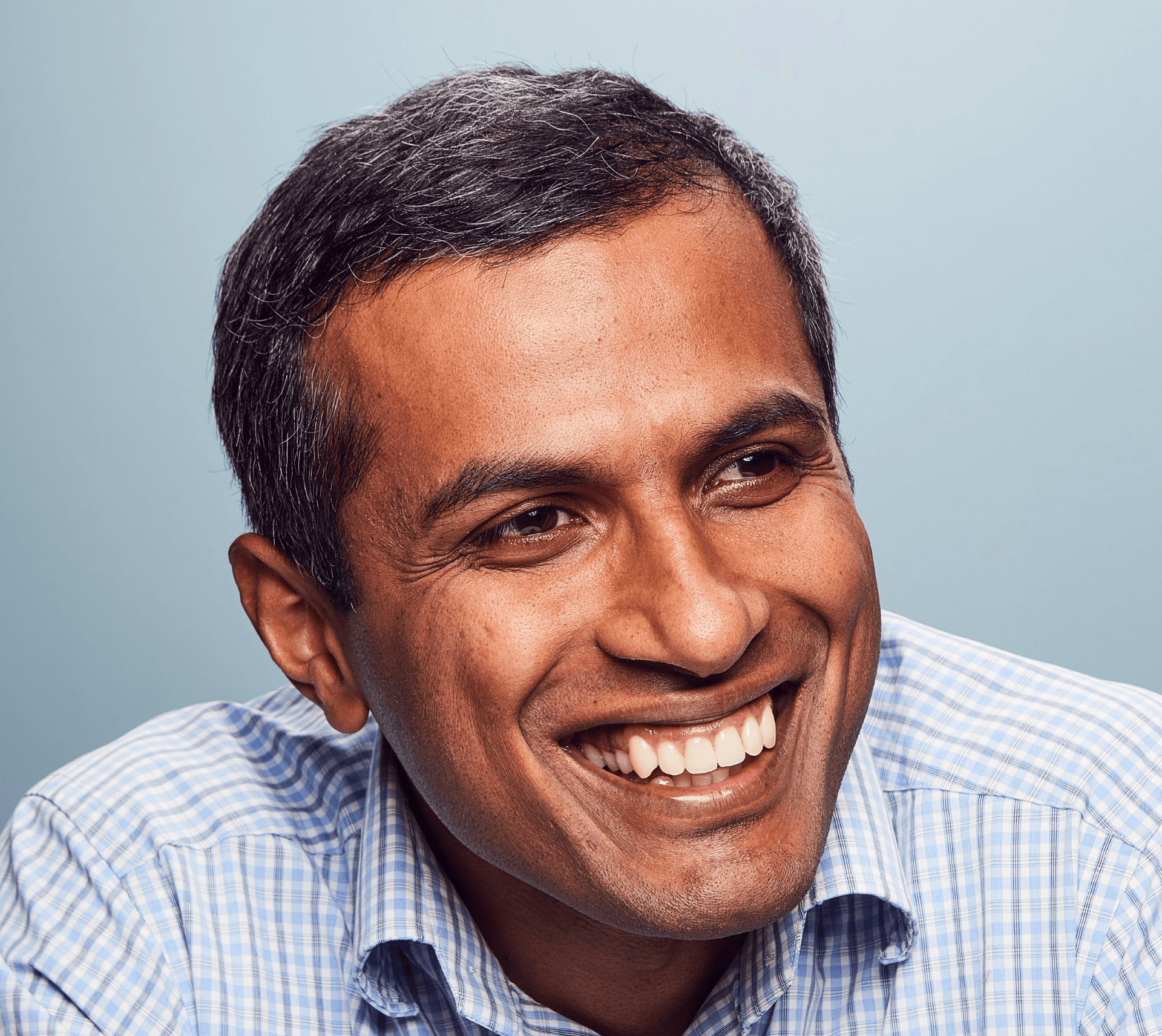
Sindura Ganapathi
Senior Advisor
Centre for Brain Research, IISc
Personal website
Sindura Ganapathi
Sindura Ganapathi
Senior Advisor
Centre for Brain Research, IISc
Personal website
Senior Advisor
Centre for Brain Research, IISc
Personal website
Team
Team
Team

Saurabh Sharma
Saurabh Sharma
Saurabh Sharma
Post-Doctoral Fellow
Post-Doctoral Fellow
Post-Doctoral Fellow

Addanki Chinni
Addanki Chinni
Addanki Chinni
Tehnical Staff Member
Tehnical Staff Member
Tehnical Staff Member

Bhavani Sankar Vijayakatu
Bhavani Sankar Vijayakatu
Bhavani Sankar Vijayakatu
Technical Staff Member
Technical Staff Member
Technical Staff Member

Naveen K. Pallekonda
Naveen K. Pallekonda
Naveen K. Pallekonda
Early Stage Researcher
Early Stage Researcher
Early Stage Researcher

Sai Keerthana Neriyanuri
Sai Keerthana Neriyanuri
Sai Keerthana Neriyanuri
Intern
Intern
Intern
Partners and Collaborators
Partners and Collaborators




Get Involved
Get Involved
Get Involved
We welcome collaborations with researchers, public health organisations, and technology partners.
We welcome collaborations with researchers, public health organisations, and technology partners.
We welcome collaborations with researchers, public health organisations, and technology partners.
Contact us at indineurofm@tanuh.ai
Contact us at indineurofm@tanuh.ai
Contact us at indineurofm@tanuh.ai
The AI Centre of Excellence in Healthcare

AI Centre of Excellence in Healthcare
Indian Institute of Science
Seventh Floor, TCS Smart-X Hub
Bengaluru, India - 560 012
Email: info@tanuh.ai
Telephone: (080) 2293 4106 | (080) 2293 4107
2026 by TANUH
The AI Centre of Excellence in Healthcare
AI Centre of Excellence in Healthcare
Indian Institute of Science
Seventh Floor, TCS Smart-X Hub
Bengaluru, India - 560 012
Email: info@tanuh.ai
Telephone: (080) 2293 4106 | (080) 2293 4107
2026 by TANUH
The AI Centre of Excellence in Healthcare
AI Centre of Excellence in Healthcare
Indian Institute of Science
Seventh Floor, TCS Smart-X Hub
Bengaluru, India - 560 012
Email: info@tanuh.ai
Telephone: (080) 2293 4106 | (080) 2293 4107
2026 by TANUH